Why Are Fibre Leads Important for Global Buyers?

Global buyers depend on reliable fibre leads to connect equipment, networks, and critical communication systems. These components may look simple, yet their performance affects signal quality, installation time, and long-term maintenance. A poorly selected lead can create excessive loss, compatibility issues, or expensive replacement work at a distant site.

Experienced procurement teams examine more than price. They review connector types, fibre modes, jacket materials, bend performance, insertion loss, and return loss. They also confirm testing procedures, packaging quality, and traceability documents. A trusted supplier should provide clear specifications and consistent inspection records. Samples matter too. A short sample cable can reveal weak connectors, tight bends, or confusing labels before a large order ships.

Global purchasing adds practical challenges. Buyers must consider customs documentation, regional standards, production capacity, and realistic delivery schedules. Communication across time zones can expose small misunderstandings. Those mistakes become costly when hundreds of fibre leads reach an unfamiliar installation site. No checklist is perfect. Specifications can change, and suppliers can make honest errors. That is why regular audits, technical reviews, and documented approvals remain valuable. Buyers should also ask how a manufacturer handles failed tests, design changes, and after-sales support. Reliable partnerships are built through evidence, not promises. When quality, compatibility, and supply continuity receive equal attention, fibre leads become a dependable part of a global network strategy.
Why Are Fibre Leads Important for Global Buyers?

Fibre Leads Defined: Types, Construction, and Core Performance Metrics

Fibre leads are short optical cables used to connect equipment, panels, and distribution points. They carry data through a glass core surrounded by cladding, coating, strength members, and an outer jacket. The core guides light, while the cladding limits signal escape. Small parts, but they control network stability.

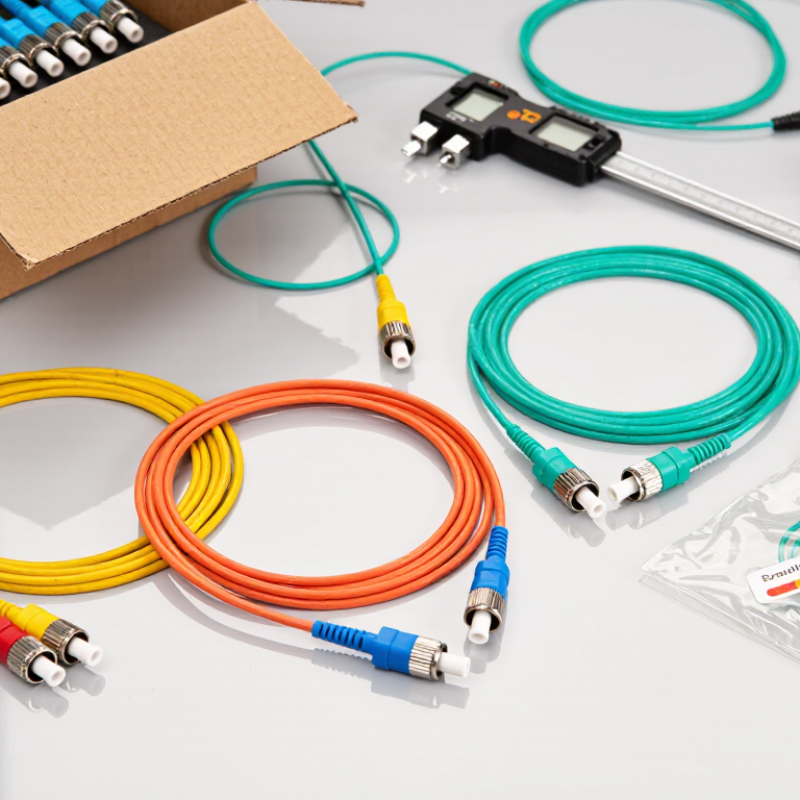
Common types include simplex and duplex leads. Simplex carries one optical path; duplex supports two-way transmission. Single-mode fibre suits long-distance links, while multimode fibre fits shorter data-centre connections.

Buyers also compare connector types, polish designs, jacket materials, and cable lengths. A tight rack may need a low-bend design. A factory floor may require a stronger, flame-resistant jacket.

Construction affects real performance. A clean endface matters as much as the cable specification. Dust can raise insertion loss after repeated handling. Key metrics include insertion loss, return loss, attenuation, polarity accuracy, tensile strength, and minimum bend radius. For example, a lead with 0.35 dB insertion loss may be acceptable for one link but waste too much power in a tight optical budget. Test reports should identify wavelength, method, serial reference, and pass limits. Endface inspection also deserves attention; visual checking alone can miss contamination. I have seen technically correct leads fail during installation because the connector keying was misunderstood. The lesson is uncomfortable: fibre selection is not only about fibre type. It depends on equipment interfaces, routing space, testing discipline, and the buyer’s actual operating environment.

Bandwidth Demand: ITU Reports 5.5 Billion People Online in 2024

Why Are Fibre Leads Important for Global Buyers?

The demand for bandwidth is no longer a future concern. ITU Facts and Figures 2024 reports that 5.5 billion people were online, representing about 68% of the global population. Every video call, cloud application, and connected device increases pressure on network infrastructure. Fibre leads support this growth by carrying large data volumes with low signal loss and minimal electromagnetic interference.

Global buyers need more than attractive pricing. Reliable fibre leads require accurate connector polishing, stable insertion loss, suitable bend radius, and verified polarity. The OECD reports continued growth in fibre broadband subscriptions across many markets, showing that access networks are becoming more fibre-dependent. In practical procurement, a small mismatch can cause installation delays or unstable links. Perfect forecasting is impossible. Still, careful specifications reduce expensive surprises.

Tips: Check connector type, fibre mode, length tolerance, and test records before ordering. Confirm local standards and packaging requirements. Ask for inspection reports, not only catalog claims. Clean end faces before connection. It sounds basic, but this step is often missed.

Signal Quality: How Insertion Loss and Return Loss Affect Network Capacity

Why Are Fibre Leads Important for Global Buyers?

Signal Quality: How Insertion Loss and Return Loss Affect Network Capacity

For global buyers, fibre leads are small components with a large effect. A clean-looking lead can still weaken a high-speed link. Two measurements deserve close attention: insertion loss and return loss. Insertion loss shows how much optical power disappears through fibre, connectors, and mating surfaces. Higher loss leaves less power for the receiver and reduces operating margin. That margin matters when networks carry dense wavelengths or long distances. Return loss measures reflected power. A higher return-loss value is generally better. Poor return loss can disturb lasers, create fluctuations, and increase bit errors. Capacity can fall before a complete link failure appears.

Tips: Request test data for every lead, not only a product datasheet. Check wavelength, connector cleanliness, polarity, and maximum loss against your link budget. Ask for factory and shipment inspection records when consistency matters. Do not compare prices before comparing measurement methods. A cheap lead with unstable performance can consume more installation time.

In field acceptance work, technicians often find contamination behind mysterious loss readings. One dust particle can change the result. Inspect and clean connectors using approved procedures. Still, specifications alone are not enough. Test conditions, equipment accuracy, and handling can alter results. I would also allow a practical margin, because real installations are rarely perfect. That assumption is easy to overlook during global procurement.

Why Are Fibre Leads Important for Global Buyers?

Signal Quality: How Insertion Loss and Return Loss Affect Network Capacity

The chart uses representative engineering values for common single-mode fibre links. Insertion loss measures signal power lost through fibre, connectors, and splices, so lower values preserve more optical budget. Return loss measures reflected power, so higher values indicate cleaner connections. Lower insertion loss and higher return loss help receivers maintain signal margin, supporting higher network capacity and more stable transmission.

Global Compliance: IEC 61754, IEC 60793, and RoHS Requirements

Why Are Fibre Leads Important for Global Buyers?

Fibre leads are small components with a large effect on network reliability. For global buyers, compliance must be checked before price and delivery. IEC 61754 defines connector interface standards, helping plugs and adapters fit correctly across compatible systems. This matters when equipment comes from different countries or production sites. A poor interface can create insertion loss, unstable links, and costly troubleshooting.

IEC 60793 covers optical fibre specifications and performance categories. Buyers should verify fibre type, attenuation, bandwidth, and operating conditions against the project design. A lead may look identical externally but perform differently inside. Technical drawings, test reports, and batch records provide stronger evidence than a product description alone. Check the details.

RoHS requirements also deserve close attention. They limit specific hazardous substances in electrical and electronic products, including restricted metals and certain flame retardants. Compliance statements should identify the applicable product, revision, and evaluation method. They should not rely on vague wording. In procurement reviews, I have seen documents that mention RoHS but omit material declarations or traceability. That gap can delay customs clearance or customer approval. Requirements may also vary by destination and product category, so buyers should confirm current rules with qualified compliance specialists. IEC conformity and RoHS compliance are related, but they are not interchangeable. A reliable fibre lead needs both technical consistency and credible documentation.

Why Are Fibre Leads Important for Global Buyers? — Global Compliance: IEC 61754, IEC 60793, and RoHS Requirements

Compliance Area What It Covers Key Requirement for Fibre Leads Buyer-Relevant Verification Global Purchasing Benefit
IEC 61754 Fibre-optic connector interfaces, including connector families, reference dimensions, and mating-interface requirements. The connector geometry and interface should match the applicable IEC 61754 connector-family specification so that compatible plugs, adapters, and equipment can mate correctly. Confirm the applicable connector type and IEC 61754 part reference; review dimensional drawings, mating checks, and insertion-loss and return-loss test results. Reduces interface mismatch, installation delays, field rework, and compatibility disputes across international supply chains.
IEC 60793 Optical-fibre specifications and test methods, including fibre geometry, attenuation, mechanical properties, and environmental characteristics, depending on the applicable part. The fibre used in the lead should be identified by its applicable IEC 60793 category and evaluated against the relevant optical and mechanical parameters. Request fibre construction details, attenuation data, dimensional measurements, proof-test information where applicable, and production test records. Supports predictable transmission performance, qualification between suppliers, and consistent network design across regions.
RoHS Directive 2011/65/EU Restriction of certain hazardous substances in electrical and electronic equipment placed on the European Union market. Materials used in the lead assembly must comply with applicable restricted-substance limits at the homogeneous-material level. Collect a supplier declaration, material declarations, and risk-based analytical test reports for cables, jackets, connectors, metals, coatings, and other relevant materials. Helps buyers meet market-access, customer-audit, and product-documentation requirements in the European Economic Area and other markets referencing RoHS.
RoHS Restricted Substances Ten restricted substances or substance groups under the RoHS framework, including four phthalates added by Commission Delegated Directive (EU) 2015/863. Maximum concentration values generally apply by weight in homogeneous materials: 0.1% for most listed substances and 0.01% for cadmium. Check evidence for lead, mercury, cadmium, hexavalent chromium, PBB, PBDE, DEHP, BBP, DBP, and DIBP; confirm any applicable exemptions and their validity. Provides a consistent screening basis for materials sourced from multiple countries and manufacturing tiers.
Optical Performance Transmission quality of the finished fibre lead, including connection-related loss and reflection performance. Measured performance should meet the buyer’s application limits for insertion loss, return loss, operating wavelength, and fibre type. Review 100% or sampling-based end-face inspection, insertion-loss results, return-loss results, wavelength conditions, and test-method details. Improves link-budget accuracy and reduces troubleshooting caused by poorly terminated or contaminated connections.
Mechanical and Environmental Reliability Resistance to handling, pulling, bending, temperature changes, humidity, vibration, and repeated mating, as required by the application. Cable construction, strain relief, bend protection, connector retention, and jacket material should be selected for the intended indoor, outdoor, or data-centre environment. Ask for applicable qualification reports, tensile and bend-test conditions, temperature range, flame rating where required, and connector durability data. Lowers premature-failure risk and helps standardize deployment requirements across different climates and installation practices.
Traceability and Documentation Records linking the finished fibre lead to its material configuration, production lot, test results, and compliance evidence. Product identification, revision control, lot traceability, and controlled compliance documents should remain consistent throughout the purchasing cycle. Require a controlled datasheet, bill of materials or material declaration, certificate or declaration of conformity where applicable, and batch-level test records. Simplifies customs, customer audits, warranty investigations, and supplier qualification in multiple jurisdictions.
Recommended Buyer Checklist A practical pre-purchase review for international sourcing and technical approval. Define connector interface, fibre category, length tolerance, jacket construction, optical limits, environmental conditions, RoHS status, and documentation requirements before ordering. Compare the technical specification with inspection plans, sample approval criteria, compliance declarations, and change-notification procedures. Creates a repeatable approval process and makes technically equivalent offers easier to compare without relying on brand information.

Note: The applicable IEC 61754 and IEC 60793 parts depend on the connector interface and fibre construction selected. RoHS assessment should be made against the current legal requirements and any applicable product-specific exemptions.

Buyer Economics: Comparing Lifespan, Compatibility, and Total Cost of Ownership

Fibre leads matter because their purchase price rarely reflects their full economic value. Global buyers should examine lifespan, compatibility, and total cost of ownership before approving a shipment. A low-cost lead may develop higher attenuation after repeated handling or poor storage. Small details matter.

A practical review checks connector type, fibre mode, wavelength, polarity, jacket rating, and bend radius. One mismatch can delay installation for hours. That assumption fails. Technicians may need adapters, replacement parts, or additional testing. Each extra step increases labor costs and extends network downtime. Clear datasheets and traceable inspection records make supplier comparisons more reliable.

Lifespan also depends on cleaning, insertion cycles, pulling force, and warehouse conditions. A durable lead can reduce replacement frequency, freight charges, and maintenance visits. Yet durability should not be confused with universal compatibility. A longer lead is not always better. Excess length can create routing problems and tighter bends inside crowded cabinets. Procurement teams should calculate the expected cost over several years, including testing, labor, failures, and disposal. I have seen spreadsheets favor the cheapest option, while field conditions later exposed hidden costs. That uncertainty deserves a buffer, especially when delivery routes, technicians, and local storage conditions vary.