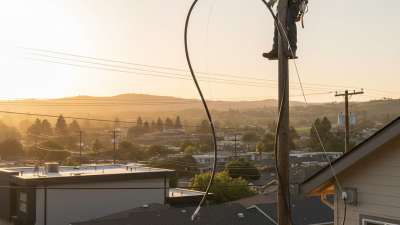
A cable drop may look like a short run of cable from a pole or terminal to a building. Yet that final connection affects installation time, signal performance, weather exposure, and maintenance costs. For global buyers, comparing manufacturers means looking beyond price. Jacket material, conductor or fiber design, connector compatibility, test documentation, and delivery consistency all matter. Small details matter.
The demand context is substantial. The International Telecommunication Union’s Facts and Figures 2024 estimates that 5.5 billion people were online, or 68% of the world’s population. That figure describes internet use, not cable-drop sales, but it shows why dependable access infrastructure remains important. The FCC’s 2024 Communications Marketplace Report also reviews fixed-broadband competition and network services in the United States. Buyers should treat such reports as market context, not proof that one cable design fits every network.
FCC Chair Jessica Rosenworcel, a broadband policy expert, has said, “Broadband is no longer a luxury. It is a necessity.” Her point concerns access, not a specific cable drop specification. That distinction is worth keeping in mind. This guide compares ten manufacturers through practical buyer checks, including product range, technical information, customization, quality controls, and export support. No ranking can replace sample testing or a careful review of project requirements. A polished catalog is not enough; even experienced teams can overlook a connector mismatch. The shortlist aims to make supplier research clearer, while leaving room for a less convenient truth: the best choice depends on the installation.

A cable drop is the final cable segment connecting a local distribution line to a building or individual service point. In fiber networks, it carries the optical connection from a nearby access point to a home, office, or small business. It is often the last visible link in a much larger network.
Small cable, big role.
Cable drops may run overhead from a pole, through underground conduit, or along a building exterior before entering the premises. A typical installation might follow a wall to a compact entry box, then continue indoors to a network terminal. The route affects the cable design: outdoor sections may need protection from moisture, sunlight, and temperature changes, while indoor sections need manageable routing and suitable fire performance. Exact requirements depend on the application and local project specifications.
A reliable drop is not just a cable that fits. Installers must consider connector compatibility, pulling tension, bend radius, and protection at entry points. Sharp turns near a doorway can damage fiber, even when the outer jacket looks intact. Copper drops have different electrical and distance limits, so they should not be treated as interchangeable with fiber. In practice, the simplest route is not always the safest one; checking the cable data sheet and site conditions can prevent avoidable service problems.
Cable-drop design is not one-size-fits-all. Aerial routes need UV-resistant jackets and strength members that tolerate wind and installation tension. Duct routes prioritize crush resistance and pulling performance. Indoor drops often require compact, flame-tested construction and low-smoke materials. Small details matter.
Standards and requirements The standards follow the installation environment. IEC 60794 covers optical-fibre cable requirements and test methods, while ITU-T G.657 specifies bend-insensitive single-mode fibres used in access networks. For indoor construction products in Europe, EN 50575 addresses reaction-to-fire performance. These standards do not make every cable interchangeable: buyers should check the exact cable type, test conditions, and local project requirements. A label alone is not enough.
Deployment figures show why designs vary. The FTTH Council Europe’s 2024 Market Panorama reported about 244 million homes passed and 121 million FTTH/B subscribers across its EU39 market. That scale includes varied building layouts and last-mile routes, not one standard drop installation. For buyers comparing Chinese manufacturers, ask for test reports covering tensile load, bend performance, water exposure, and fire classification where applicable. Then match the results to the actual route. It is easy to over-focus on price; field conditions can make that comparison incomplete.
Evaluating a cable drop manufacturer starts with the installation conditions. Ask whether the cable is intended for aerial spans, building entry, or another specific route. Request clear specifications for conductor size, insulation, jacket material, and rated tensile load. The figures should match your drawings, not just a general product sheet. Small differences matter.
Review evidence, not promises. Ask for recent test reports, material traceability, and inspection records linked to production batches. Check how the factory controls conductor diameter, insulation thickness, and finished cable length. A sample can reveal rough printing, uneven jackets, or inconsistent packaging. Still, one sample cannot represent every production run.
Discuss change control before placing a large order. Confirm how the manufacturer handles substitutions, revised drawings, and defects found during incoming inspection. A capable supplier should explain these steps plainly and answer technical questions without rushing you. No checklist catches everything. I would also compare sample results with batch records, because documentation can look tidy while a small production detail slips through. That is worth questioning.
This is a ten-point supplier evaluation matrix, not a verified ranking of manufacturers. “Cable drop” can refer to different products, including electrical service-drop cables and fiber-optic drop cables; confirm the product type and applicable requirements before comparing suppliers.
| No. | Evaluation Dimension | What Buyers Should Verify | Useful Evidence or Reference |
|---|---|---|---|
| 1 | Product type and application | Confirm whether the product is an electrical service-drop cable, a fiber-optic drop cable, or another cable type. Define its installation environment, system interface, and intended use. | Product datasheet, construction drawing, cable designation, and written confirmation of intended application. |
| 2 | Applicable standards | Check that the proposed standard matches the cable type and destination market. Do not treat standards for power cables and optical-fiber cables as interchangeable. | Examples include IEC 60502-1 for certain extruded-insulation power cables, the IEC 60794 series for optical-fiber cables, and UL 854 for service-entrance cable where applicable. Confirm the exact edition and scope. |
| 3 | Conductor or fiber specification | For electrical cables, compare conductor material, nominal cross-sectional area, construction, and resistance requirements. For fiber cables, specify fiber type, fiber count, and relevant optical parameters. | Construction schedule and test results against the agreed specification; IEC 60228 is a reference for conductor classes and conductor resistance in applicable cables. |
| 4 | Insulation, sheath, and construction | Review material type, layer thickness, reinforcement or messenger arrangement, dimensions, and environmental ratings. Confirm that the construction drawing matches the purchase specification. | Controlled drawings, material declarations, dimensional inspection records, and an approved pre-production sample when required. |
| 5 | Type, routine, and acceptance testing | Agree which tests apply to the specific cable, which are performed on each production lot, and what constitutes acceptance. Request traceable reports rather than a generic test summary. | Test plan tied to the selected standard and purchase specification, with sample identification, test date, results, and laboratory details. |
| 6 | Fire and environmental claims | Verify each claim—such as flame performance, smoke, halogen content, or restricted substances—against the exact test method and product construction. These properties should not be inferred from a general certificate. | Relevant reports may refer to IEC 60332-1-2 for a single cable flame-propagation test, IEC 60754-1 for halogen-acid gas, or IEC 61034 for smoke density, when applicable to the claim. |
| 7 | Quality management and traceability | Check production controls, inspection records, nonconformance handling, and the ability to trace finished cable back to production and material batches. Confirm certificate scope and validity. | Quality-system certificate and scope, sample inspection records, lot identification method, and documented corrective-action process. ISO 9001 certification alone does not prove product compliance. |
| 8 | Production capacity and delivery | Ask whether the supplier can meet the required quantity, packaging, production schedule, and shipping plan. Capacity, minimum order quantity, and lead time vary by product and order. | Order-specific quotation, production schedule, packaging specification, and confirmation of delivery terms and shipment documentation. |
| 9 | Export and destination-market readiness | Confirm that product markings, documentation, packaging, and any required approvals meet the destination market’s rules and the buyer’s import requirements. | Market-specific compliance documents where required, proposed cable marking, packing list details, and confirmation that certificates cover the offered model and construction. |
| 10 | Commercial terms and after-sales support | Compare quotations on the same technical basis, including quantity, packaging, inspection, delivery terms, warranty, and remedies for nonconforming goods. | Itemized quotation, agreed technical schedule, sample-approval record, warranty terms, and written claim-handling procedure. |
This buyer-focused overview compares ten capability-based profiles of Chinese cable drop manufacturers, rather than ranking named companies. One profile specializes in flat fiber drop cable for compact routing. Another focuses on round designs suited to tougher installation conditions. A third offers indoor cable with low-smoke materials. Others emphasize aerial spans, armored construction, pre-terminated assemblies, custom lengths, connector options, export packaging, or production testing. These differences matter: a cable used along a building façade may need different construction from one routed through an indoor corridor.
The profiles are most useful when buyers check evidence, not just product descriptions. Request a current datasheet, construction drawing, and sample from the same product range. Ask how the supplier controls fiber alignment, jacket dimensions, and connector inspection. Small inconsistencies can complicate installation. A factory’s stated capacity also deserves a closer look; capacity figures alone do not confirm stable quality or delivery performance. Some details may still remain unclear after an initial review.
Tips: Compare samples against the written specification, and confirm bend radius, tensile requirements, and operating temperature before ordering. Ask for test records tied to the quoted cable type. If a supplier’s answer feels vague, pause and clarify it in writing.
Verifying a cable-drop supplier requires evidence from the factory, not just a polished catalogue. Request a current product specification, material traceability records, and test reports tied to the exact cable construction. Check optical attenuation, tensile performance, and weather-resistance results against your own project requirements. Then compare a pre-production sample with goods from a later production lot. Small differences matter.
Ask who performs each test, which method they use, and whether the report identifies the tested model and date. The World Bank’s 2023 Logistics Performance Index covered 139 economies and assessed customs, infrastructure, shipment arrangements, logistics competence, tracking, and timeliness. These measures are a useful reminder: supplier quality is only one part of reliable delivery. Confirm production capacity, packaging dimensions, lead times, and shipment milestones in writing. A checklist can still miss a weak point. I would not rely on certificates alone; document checks should be followed by sample testing or an independent factory inspection when the order justifies it.
For international sourcing, agree on the named delivery location, payment milestones, inspection criteria, and the process for handling damaged or delayed shipments before production starts. Keep a dated record of approved drawings, labels, and packaging photographs. Ask for a small pilot order if specifications or logistics are unfamiliar. It may cost more per unit. It can reveal problems before a full container ships.