10 Best Environmentally Friendly Fans for Businesses
For businesses, choosing a fan is more than a comfort decision. It can affect electricity use, noise levels, maintenance routines, and the experience of staff and customers. Environmentally Friendly Fans offer a practical way to move air while paying closer attention to energy consumption and product lifespan. But a green label alone proves little.
Energy-efficiency expert Amory Lovins is often credited with the line, “The cheapest energy is the energy you don’t use.” That idea offers a useful lens for comparing commercial fans. Look beyond the product name: check airflow ratings, power draw, motor design, speed controls, warranty terms, and whether replacement parts are available. A fan that runs quietly above a busy shop floor may suit one business; a dusty workshop has different needs. Small details matter.
This guide introduces ten options for different business settings, from offices and cafés to warehouses and studios. It considers efficiency alongside durability, usable controls, and everyday operating conditions. No single fan will fit every room. A highly efficient model can still be the wrong choice if it moves too little air or demands frequent repairs. And product specifications do not tell the whole story. Treat comparisons as a starting point, then match each model to your space, usage hours, and maintenance capacity.
Understanding the Environmental Impact of Business Fans
A fan’s environmental impact extends beyond the electricity shown on a utility bill. It includes the energy used during operation, materials used in manufacturing, and replacements over time. The International Energy Agency’s 2024 Global Status Report for Buildings and Construction estimates that buildings account for 32% of global energy demand and 34% of energy-related carbon dioxide emissions. Fans are only one part of that picture. Still, in a busy shop or warehouse, hours of daily operation can make small efficiency differences matter. The label is not the whole story.
The U.S. Energy Information Administration’s 2018 Commercial Buildings Energy Consumption Survey assigns about 8% of commercial building energy use to ventilation. That figure covers ventilation systems, not fans alone, so it should not be treated as a direct estimate of fan consumption. Context matters. A fan running at full speed in a quiet stockroom may waste energy, while a poorly placed unit may fail to cool occupied areas. Dust on blades and blocked grilles can also reduce airflow. These are ordinary details, but they are easy to overlook. The data has limits, too: building types and operating schedules vary, and real-world performance rarely matches a tidy specification sheet.
Key Factors for Evaluating Eco-Friendly Commercial Fans
For businesses, an eco-friendly fan should move enough air without consuming more electricity than the space requires. Start with room size, ceiling height, occupancy, and heat from equipment. Measure the room. A fan suited to a small office may struggle in a high-ceiling workshop. Compare airflow and power use together, rather than choosing by airflow alone. Check whether speed controls allow staff to reduce output during quieter periods. That small adjustment can matter across long operating hours.
Noise and maintenance deserve equal attention. In a reception area, a steady hum can disrupt conversation; in a stockroom, it may matter less. Ask for sound data at several speeds, and consider how the fan will be cleaned. Dust on blades can affect performance and create extra work. Materials, repair options, and expected service life also shape environmental impact. A low purchase price is not the whole picture. Neither is an efficiency label, by itself. Review test conditions and compare products on the same basis. Real rooms rarely match perfect test setups, and that makes selection less tidy than a product sheet suggests. If possible, trial a unit in the intended space before committing to several.
Types of Energy-Efficient Fans for Business Use
10 Best Environmentally Friendly Fans for Businesses
Types of Energy-Efficient Fans for Business Use
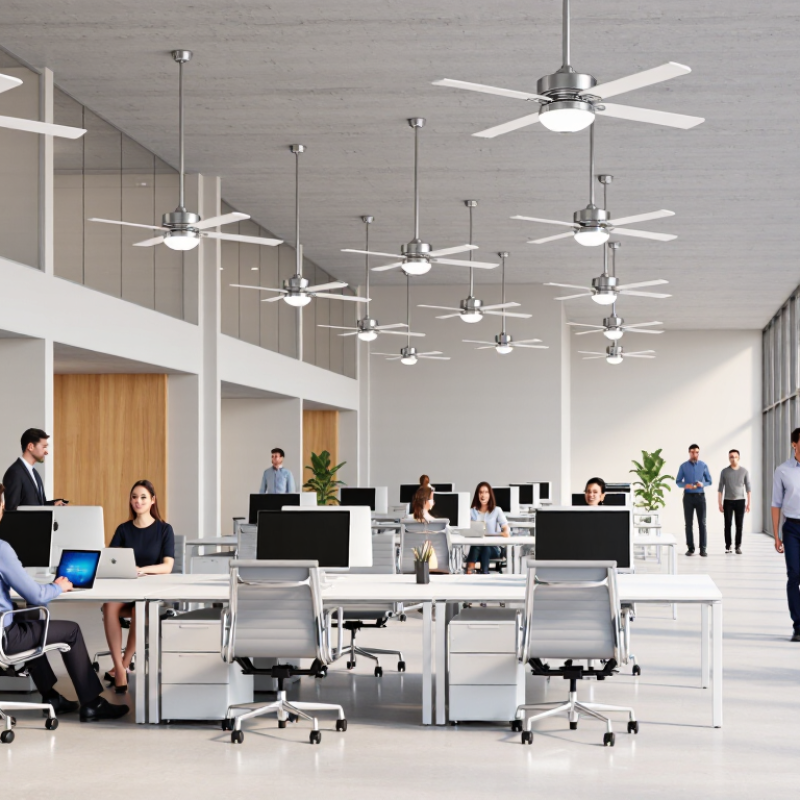
Energy-efficient fans serve different jobs, so choosing by room and workflow matters more than choosing the largest model. Ceiling fans suit offices, cafés, and smaller retail spaces. They circulate air across occupied areas and may support a modest thermostat adjustment when conditions allow. For high-ceiling warehouses, high-volume, low-speed fans move broad columns of air at a gentle pace. They are not magic.
Pedestal and wall-mounted fans work well where equipment or stock blocks ceiling airflow. They let staff direct a breeze toward packing stations, loading bays, or temporary work zones. In workshops, guarded industrial fans may provide stronger airflow, but check noise, dust exposure, and maintenance access before installation. Exhaust fans serve another purpose: they remove warm or stale air rather than simply recirculating it. An oversized fan may create drafts and use more electricity than needed.
Tips: Compare airflow ratings and input watts, then estimate operating hours. Clean blades and grilles regularly; dust can reduce performance. Test placement during a busy shift, not an empty-room walkthrough. Comfort varies with humidity, clothing, and task intensity, so staff feedback should shape final settings. Keep a simple energy log.
10 Best Environmentally Friendly Fans for Businesses
For businesses, an environmentally friendly fan should match the room, operating schedule, and existing cooling system. ENERGY STAR reports that certified ceiling fans use about 60% less energy than conventional fan-and-light units. That is useful, but the label alone does not show whether a model suits a high-ceiling warehouse or a small meeting room. Compare airflow efficiency, measured in cubic feet per minute per watt, and check that controls make it easy to reduce speed when full airflow is unnecessary. Quiet matters, too. A fan that staff switch off because it distracts them saves nothing.
The U.S. Department of Energy says ceiling fans can let occupants raise thermostat settings by about 4°F without sacrificing comfort. Fans do not cool the air itself; they create air movement that helps people feel cooler. Use them only in occupied areas, and review seasonal settings with facility staff. For open workspaces, larger fans may move air across a broad floor area; compact units can target a desk or service counter. Check mounting clearance, cleanable blades, and motor access before installation. One detail is easy to miss: a fan’s savings depend on how people use it. I would track electricity use and comfort complaints after installation rather than assume the projected savings will appear.
How to Choose a Fan for Your Business Needs
Choosing a fan for a business starts with the room, not the product label. Measure the floor area, ceiling height, and distance between workstations. A quiet ceiling fan may suit a small office, while a warehouse often needs larger units that move air across high shelves. Check airflow ratings, noise levels, controls, and maintenance access before comparing prices. A fan that is hard to clean may lose efficiency as dust builds up.
ENERGY STAR reports that certified ceiling fans are, on average, 60% more efficient than conventional fan-and-light units. That figure is useful, but it does not guarantee savings in every workplace. Match fan size and speed to the space, and use variable controls where occupancy changes during the day. The U.S. Department of Energy also notes that ceiling fans can help occupants feel comfortable at a higher thermostat setting. Fans cool people, not rooms. Switch them off in empty areas.
Walk the site during a busy shift. Notice stale corners, papers lifting from desks, or a draft aimed at one worker. Small details matter. Airflow can feel uneven even when a fan’s rating looks strong. Ask staff to test the proposed settings, then review energy use after installation. This step takes time, and the first layout may still need adjustment.